
- June 11, 2025
- RNicholsPhD
- No Comments
Points of discussion
- Three facets in family court cases
- Facet 1-Legal and physical aspects
- Facet 2-Parenting percentages
- Facet 3-Temporary and final rulings
- In essence...
Introduction
Family court decisions can have lasting effects on parent-child relationships, which can affect children’s emotional and physical development.
When a relationship ends, partners who have children together, whether married or unmarried, must make decisions about their children’s lives.
When parents are unable to agree on decisions and living arrangements for their child, they may turn to family courts to formalize a parenting arrangement (Sammut, 2018; Stewart, 2019).
Court decisions for the legal and physical aspects are made in a temporary or initial family court decision (American Bar Association, 2020) and a final or permanent family court decision Cancian et al. (2014).
Considerations..
The court considers different factors when determining parenting arrangements, including financial, geographical logistics, parental resources, and, most importantly, the child’s needs.
Some court matters are contentious, involving parent-child contact problems (PCCP) that can affect the relationship (Garber, 2020; Pruett et al., 2023), which includes a multitude of potential factors and scenarios and factored in the court decisions.
Parenting plans...
Parenting arrangements or parenting plans, previously known as custody arrangements, involve the legal aspect, or decision-making, in four areas: education, medical care, religion (Caulley, 2018; Herman, 2021), (Caulley, 2018: Herman, 2021), and extracurricular activities (Herman, 2021); as well as the physical aspect, i.e., where the child lives and sleeps and the amount of time each parent spends with the child (Tornello et al., 2013).
3 facets in family court cases
Several key terms are used when referring to court decisions for parenting plans. Developing parenting plans is a process that aims to determine the legal and physical decisions that are in the best interest of the child (Sammut, 2018; Stewart, 2019).
This typically encompasses three crucial elements of family court decisions:
Note-definitions and legal parameters associated with these terms may vary among the states.
- Facet 1 - legal and physical aspects
- Facet 2 - allocation of percentages for each parent
- Facet 3 - temporary and final court decisions
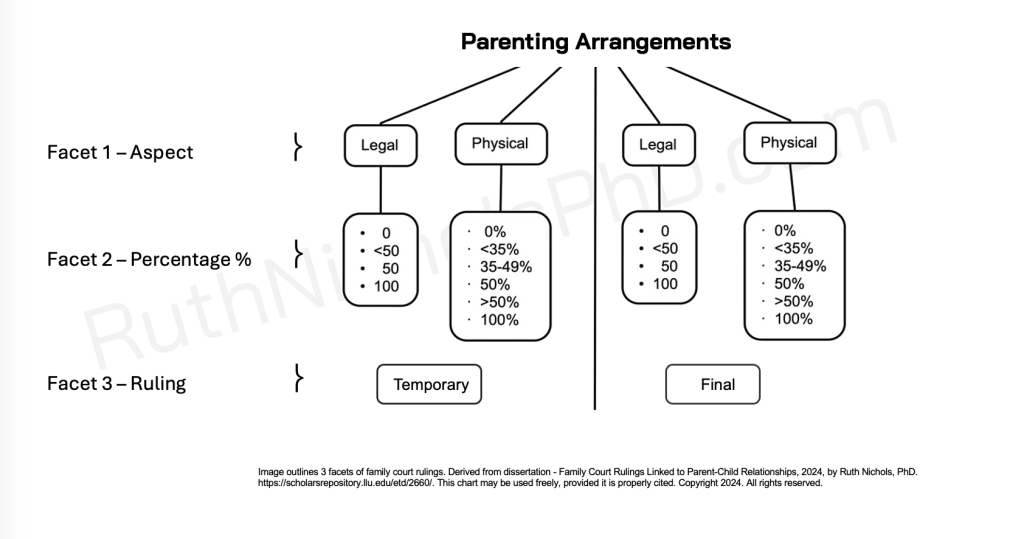
Three Facets of Parenting Arrangements
Note. Aspects and rulings reflect statutes in the U.S. Percentages reflect the literature and aim to extrapolate parenting arrangements
Facet 1 - legal and physical aspects
The first facet represents the legal and physical aspects of the parenting arrangement.
Each of these aspects is addressed in both the temporary and final rulings; however, the details of the plan could be revised between the temporary and final decisions.
Legal aspect
The legal aspect of a parenting plan involves the decision-making process regarding the child’s education, medical care, religion, and recreational or extracurricular activities (Caulley, 2018; Herman, 2021).
Some rulings may split parts of the legal aspect between the parents, or exclude one parent from decision-making in the four legal areas entirely.
Parenting plans regarding the legal aspect fall into four percentage categories: 0%, <50%, 50%, and 100%.
Physical aspect
The physical aspects of a parenting plan, referred to as parenting time, focus on where the child lives and sleeps (Tornello et al., 2013) parenting time are outlined in the plan, including explicit instructions about where the child will reside throughout the year, including weekends, holidays, and summer vacations.
The physical aspect of a parenting arrangement is measured into six percentage categories: 0%, < 35%, 35-49%, 50%,> 50%, and 100%.
Facet 2 - parenting percentage
The second facet explores the percentages allotted to each parent regarding the legal and physical aspects of parenting arrangements designated in the temporary and final court decisions.
Legal aspect
Parenting plans regarding the legal aspect fall into four percentage categories: 0%, <50%, 50%, and 100%.
For example...
Accordingly, 0% indicates one parent has no decision-making ability in any of the four areas; <50% indicates one parent has decision-making options in only one to three areas; 50% indicates both parents share decision-making for all four areas; and 100% indicates one parent has full decision-making ability in the four areas.
Also, a parent’s legal decision-making rights or physical parenting time may change between the temporary and final rulings.
Physical aspect
The physical aspect of a parenting arrangement is measured into six percentage categories: 0%, < 35%, 35-49%, 50%,> 50%, and 100%.
For example...
Accordingly, 0% indicates one parent has no parenting time, including no supervised visitation; a percentage of less than 35% parenting time may indicate a parent with supervised visitation, in which parent-child time takes place in the presence of a court-approved attendant.
Parents in this category have at least 35% to less than 50% parenting time.
A 50% category indicates parents share the responsibility of the living arrangements for their child.
A percentage of more than 50% reflects one parent has increased time with their child.
A percentage of 100% indicates a parent with sole rights of the child. While research literature defines sole physical custody as a parenting arrangement in which the child spends most of their time with one parent (Braver & Votruba, 2018), Steinbach and Augustijn (2021) define sole physical custody as sharing less than 30% of parenting time with the other parent, as decided by the courts.
How were parenting percentages determined?
Percentages in parenting plans were based on four criteria outlined in the literature.
- A minimum of 35% parenting time benefits the child*
- Equal amounts of time to each parent benefits the child**
- Shared parenting agreements have 40% parenting time***
- Fills in the gaps percentages of less than 35% and 50%.
*Research literature (Nielsen, 2018).
** 50% parenting time, based on literature that suggests that allotting equal amounts of time to each parent could benefit the child, although this could be difficult due to the child’s changing needs, particularly as they grow older (Garber, 2020; Nielsen, 2018).
***Based on a Canadian study (Bala et al., 2017), categorizes shared parenting agreements as those in which each parent is allocated 40% of parenting time.
Facet 3 - temporary and final rulings
The third facet of understanding family court matters involves temporary and final court rulings.
Typically, after one parent files a parenting arrangement, a judge issues a temporary ruling initially approving the plan (American Bar Association, 2020), which is enforced until the court makes its final ruling.
These final rulings are rendered after all issues with the parenting arrangement have been resolved (Cancian et al., 2014a).
Note-Time frames for this process vary among states.
In essence...
The family court’s approach to determining parenting time has changed over the last few decades. This section discussed the facets of court decisions and the terminology used.
Related articles

“Divide the living child in two, and give half to the one, and half to the other” (JPS Hebrew-English Tanakh, 1985/2014, 1 Kings 3:26).

It is necessary to consider multiple factors, adopt a child-centered approach, and thoroughly examine all elements of the situation to ensure that court decisions are made in the child’s best interest.