- June 11, 2025
- RNicholsPhD
- No Comments
Points of discussion
- Individual: characteristics and qualities of the focal person
- Microsystem: communications in the immediate environment
- Mesosystem: interactions that influence the child
- Exosystem: social system experinces that influence the child
- Macrosystem: cultural values and policymaking
- Chronosystem: dimension of time with family experiences
- In essence...
Introduction
Bronfenbrenner’s bioecological theory is an appropriate framework for understanding the family and court system connections.
A bioecological system framework is especially relevant to understanding the role of parental alienating behaviors in family court matters. In a recent article, Doǧan and Aytekin (2021) provided an in-depth analysis of alienating behaviors from a bioecological perspective.
The following discussion on bioecological systems theory will provide a detailed summary of the findings of Dogan et al. (2021), along with other relevant literature.
Bronfenbrenner developed a bioecological approach to human development, incorporating five interactive systems (Bronfenbrenner, 1979) focused on the individual: microsystem, mesosystem, macrosystem, exosystem, and chronosystem.
- Characteristics were categorized into three types: demand characteristics, which include observable attributes such as age, gender, and physical appearance; resources available to the child. such as intelligence and social skills, and forced characteristics or innate traits, such as a sense of control and temperament (Tudge et al., 2009).
- The microsystem includes interactions that the individual experiences regularly, e.g., church, family, friends, after-school care, and sporting activities.
- The mesosystem is the interaction process of the microsystems.
- The exosystem is the connection between the interactions of the individual and contextual factors, including community and social influences.
- The macrosystem reflects societal beliefs and the cultural influences on and resources available to the individual. Macrosystem: cultural values and policymaking
- The fifth system, titled the chronosystem, added the dimension of time (Bronfenbrenner, 1994).
These nested systems constantly interact (Ebersohn & Bouwer, 2015) reflecting changes in other systems, offering a perspective for understanding the individual and interrelatedness among the contextual systems.
Bronfenbrenner’s bioecological theory is a multidimensional model encompassing all social contexts influencing the child, helping to understand the interconnected concepts of family and court system, shown in this article (created with (Life Design Log, 2020).
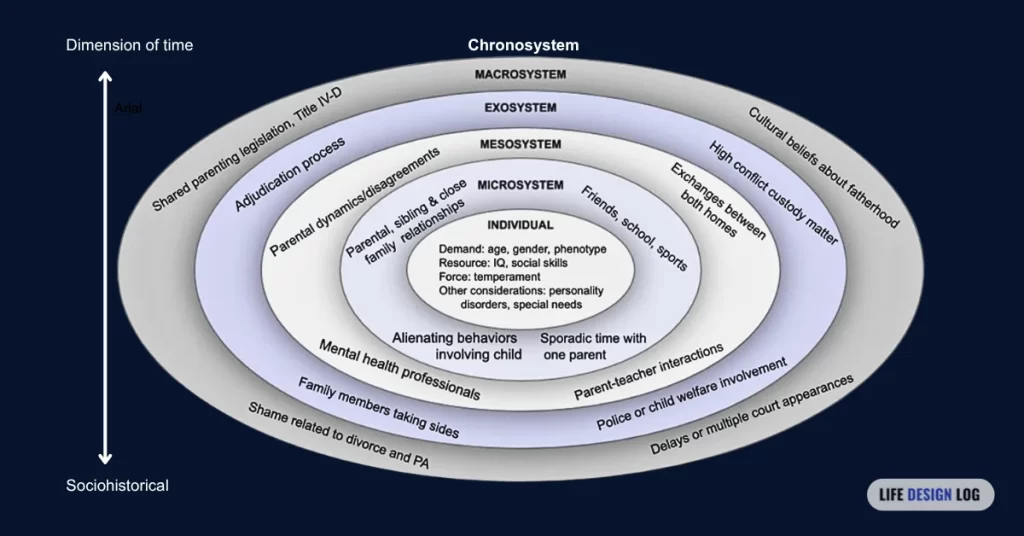
Note-The diagram illustrates instances of behaviors and circumstances families might encounter in family court.
Events and scenarios within each system are derived from studies assessing child, family, and parental experiences outlined throughout this paper.
Permission to use Life Design Log granted 8/9/2024.
Individual
Bronfenbrenner recognized biological traits and genetic facets in each person (Bronfenbrenner & Ceci, 1994) and believed individual qualities played a role in social settings and personal experiences (Bronfenbrenner, 2005).
Characteristics were categorized into three types: demand characteristics, which include observable attributes such as age, gender, and physical appearance; resources available to the child. such as intelligence and social skills, and forced characteristics or innate traits, such as a sense of control and temperament (Tudge et al., 2009).
Research by Doǧan and Aytekin (2021) found that family interactions and home environment influence the child’s growth and development. Further, Doǧan and Aytekin (2021) explain that parental alienating behaviors occur within each system, i.e., individual, microsystem, mesosystem, exosystem, macrosystem, and chronosystem, and will be discussed in later sections.
For example...
- A shy, reticent child may require more time to warm up to a parent after separation and could benefit from a parenting plan with weekly exchanges between parental homes rather than two exchanges per week.
- For optimal care of a child with sensory challenges such as auditory or visual issues, it is necessary to consider parenting arrangements carefully.
Microsystem
The microsystem involves interactions in the immediate environment of the focal individual, i.e., the child (Tudge et al., 2009), including face-to-face communications (Härkönen, 2001) and direct communications with parents, teachers, friends, or close relatives.
For example...
- Siblings who are expected to either team up or take sides, promoting discord in an otherwise close relationship, interacting with both parents on a daily basis, or developing new patterns of interaction (Ebersohn & Bouwer, 2015) that require the child to interact with step-parents or siblings.
- Asking the child to pass messages, “spy” on the other parent, or be exposed to inappropriate information such as family finances, sexual relationships, and other adult issues falls into the microsystem.
In addition, Doǧan and Aytekin (2021) report that extended family members may also exhibit parental alienating behaviors.
For example...
- Grandparents, aunts, and uncles who regularly see the child might attempt to limit the child’s contact with the parent, or interfere with communication. This might change the child’s perception of the parent and influence the child’s emotional security.
Mesosystem
Moving outward is the mesosystem, which includes the interaction of individuals in the microsystem who influence the child (Bronfenbrenner, 1979).
For example...
- Potential scenarios within the context of family court matters may include communication between parents, the child’s transitions between parental homes, extended family relationships (aunts, uncles, cousins, or grandparents), and parent-teacher communications about how the child copes with the family court matter.
- Disagreements among the parents about the child regarding education, religion, schedules, or other factors pertaining to their child’s functioning fall into the mesosystem.
- One parent not inviting their co-parent to a school event (Doǧan and Aytekin (2021) reference a study by Steinberg, (2006).
- Extracurricular activities and school events that the parent without legal custody would have attended (Steinberg, 2006) create a scenario where the child is the victim.
- A parent may “forget” to inform their co-parent about school events, leading the child to believe the parent does not care enough to attend, while the parent engaging in the parental alienating behaviors appears engaged and attentive.
- A parent insinuating to the child's school that the co-parent is not a suitable caretaker for the child.
Exosystem
The next layer, the exosystem, expands on the mesosystem (Way, 1990), reflecting the larger social system and situations in which the child is affected but not directly involved.
According to Doǧan and Aytekin (2021), although the alienation process is not a result of the child’s actions but arises from interactions between both parents and the extended family, the child may experience emotional abuse.
For example...
- One parent’s interaction with a co-parent’s employment (work schedule or income); the child’s education (academic performance, school activities); the family’s social circle (church, community, or family interactions); and the legal process (evaluations, legal counsel, or court appearances).
- Family members siding with one parent against the other (Johnston et al., 2009).
- Involving police or child protective services (CPS) in situations regarding DV and IPV
- Legal assessments or services for the child (attorney, guardian ad litem).
- A parent speaking untruths to the child about the other parent may negatively influence the child’s perceptions of that parent (Doǧan and Aytekin, 2021, cited in Toran, 2017).
- The process of a high-conflict family court matter also falls in the exosystem category.
According to Doǧan and Aytekin (2021), although the alienation process is not a result of the child’s actions but arises from interactions between both parents and the extended family, the child may experience emotional abuse.
For example...
- Parents involved in high-conflict cases who seek increased parenting time or the enforcement of an existing parenting ruling are considered part of the exosystem.
Macrosystem
The outer layer of the system, or macrosystem, consists of belief systems, cultural values, and policymaking (Bronfenbrenner, 1979). Issues such as court-ordered parenting time changes, court proceedings delays, ongoing family court issues, and modifications to shared parenting laws also fall in the macrosystem.
For example...
- Other possible examples in this layer involve cultural expectations surrounding marriage, divorce, and separation, or the shame a parent experiences when they are unable to spend time with their child due to court decisions, parental conflict, work schedules, financial constraints, or logistical problems (Bronfenbrenner, 1979).
- The shame a parent experiences when they are unable to spend time with their child due to court decisions, parental conflict, work schedules, financial constraints, or logistical problems (Bronfenbrenner, 1979).
- Issues such as court-ordered parenting time changes, court proceedings delays, ongoing family court issues, and modifications to shared parenting laws also fall in the macrosystem.
Doǧan and Aytekin (2021) discuss informing the public about parental alienating behaviors and spreading accurate information to generate awareness.
For example...
- The authors recommend disseminating reliable information about parental alienating behaviors and the experiences of parents and children to raise awareness about the necessity of policy changes in family court matters (Doǧan & Aytekin, 2021).
- The authors report that creating societal awareness of parental alienating behaviors and enlightening legal and mental health professionals about the subject is a task that takes place at the macrosystem level.
Chronosystem
The chronosystem adds the dimension of time to the ecosystem (Addison, 1992) and incorporates the sociohistorical events contributing to the family’s current situation (Neal & Neal, 2013).
For example...
- Bronfenbrenner distinguishes between personal time, i.e., the microsystem, and socio-cultural influences, i.e., the macrosystem (Donelli & Matas, 2020).
- Doǧan and Aytekin (2021) describe changes as either normative or non-normative. Normative changes include age, school-related milestone events, and marriage; non-normative changes include divorce, a death in the family, or a serious illness.
- Parental alienating behaviors could fall into the chronosystem based on long-term changes to parent-child dynamics (Doǧan & Aytekin, 2021).
- Another consideration is the age of a child during a family court matter.
- A younger child might react differently to parental conflict than an older child, who may have developed more sophisticated coping mechanisms and verbal skills.
In essence...
In essence, this provides insight in how family members are influenced by family court matters and of how court decisions impact parent-child relationships.
This provides a lens for understanding the interconnected concepts of the family and court system, explores how the various levels of the ecosystem interact, and discusses its potential influence on family court matters.
Related articles
One or both parents may engage in parental alienating behaviors (Balmer et al., 2018), attempting to negatively affect or even destroy the child’s bond with the other parent.
Literature suggests that one or both co-parents can be perceived as victims of parental alienating behaviors (Scharp et al., 2021), as is the child.
One of the earliest legal child support cases occurred in New York in 1858. The court acknowledged that “A parent is under a natural obligation to furnish necessaries for his … children…”.